
German
Habe nun, ach! Philosophie,
Juristerei and Medizin,
Und leider auch Theologie
Durchaus studiert, mit heißem Bemühn.
Da steh' ich nun, ich armer Tor,
Und bin so klug als wie zuvor!
—(Faust I, 354-359)
Poor Faust, who had so many majors and still ended up no smarter than before! He should have studied German!
To study German is to work toward proficiency in an interesting language, and to study the histories and cultures of a variety of countries and peoples. Studying German offers practical and professional advantages: speaking German and understanding German culture opens doors, as German is the first language of about 120 million people in Austria, Germany, Liechtenstein, and Switzerland, and also spoken by minorities in France, Italy, Luxemburg, the Czech Republic, Belgium, and Russia. Additionally, Germany's strong economic position has also led to the use of German as the preferred language of commerce in several Eastern European countries. Germany also boats top-notch, federally funded public universities that are open to international applicants with requisite proficiency in German.
But studying in our German program also provides a foundational and wholistic humanities education, attending broadly to multidisciplinary methods, approaches and topics in comparative literature, philosophy, history, Jewish studies, environmental studies, media studies and gender and sexuality. We specialize in critical thinking and reading practices in our courses, which are built around student engagement, self-discovery, and intellectual development.
German makes a great double major. Combinations have included:
- Linguistics
- English
- Mathematics
- Art history
- Film
- Music
- History
- Political science
- Optics
- Psychology
- Comparative literature
- International Relations
- Biomedical Engineering
At the University of Rochester, our students immerse themselves in the German language and culture through coursework, film screenings, literary engagement, Deutschtisch, invited speakers, theater performances, study abroad, and more. Our program helps to prepare students for careers that stress critical thinking and cross-cultural communication, and our students have gone on to work internationally, and continue their education in medical school, graduate programs, and law school.
Coursework and Curriculum
Within the major, minor, and clusters, required courses may be substituted by courses taken in Germany, at the Eastman School of Music and other German programs. Please contact Lisa Cerami by email at lisa.cerami@rochester.edu for questions pertaining to coursework and curriculum!
Below is information on:
- German major requirements
- German minor requirements
- German clusters
- Study abroad
- Language placement
- Contact information
German Major Requirements
The German major has a total of 11 required courses.
FOUNDATION COURSES (fulfill upper-level writing):
CLTR 200 Topics in Critical Thinking
CLTR 389 MLC Research Seminar
CORE COURSES:
GRMN 151: Intermediate German I
GRMN 152: Intermediate German II
GRMN 200: Advanced Conversation and Composition
GRMN 202: Introduction to German Cultural Studies
GRMN 203: Introduction to German Literature
GRMN 256: Advanced Topics in German Studies
ELECTIVE COURSES:
Three upper-level elective courses in German literature and culture
Minor Requirements
The German minor has a total of 5 required courses.
- GRMN 151: Intermediate German I
- GRMN 152: Intermediate German II
- GRMN 200: Composition and Conversation
- GRMN 202: Introduction to German Cultural Studies
- GRMN 203: Introduction to German Literature
German Clusters
Introduction to German Language and Culture (H1GRMN004)
This cluster introduces students reading, writing, speaking, listening in German in cultural and historical context. For the elective course, a student can choose to continue with intermediate German or an English language course focusing on German media, culture, history, politics, and society.
Intermediate German Language and Culture (H1GRMN005)
This cluster includes two intermediate courses in German, building on the foundation established in the elementary sequence. Students also choose a third course either in German at the advanced level, or an English language course focusing on German media, culture, history, politics, and / or society.
Advanced German Language and Culture (H1GRMN006)
In this cluster, an advanced student of German will be able to enhance linguistic and cultural proficiency in German through the study of a broad range of topics and themes. Required courses for the cluster are offered in German.
Study Abroad
In this German program we believe: Studying abroad will change your life! To study abroad is to encounter another culture up close, opening your mind to different ways of life and perspectives. We strongly encourage all majors and minors to participate in study abroad as part of their academic career, and we help students to find study abroad opportunities that work for them and their other majors and scheduling commitments.
Our program facilitates a 4-week study abroad program in Berlin, Germany each summer, led by a faculty member from our program or the German program at Eastman School of Music. Our Berlin Program consists of intensive language classes offered through the Neue Schule, and lots of cultural programming in and around Berlin and beyond! Students receive 4 credits that count toward and / or substitute for major and minor requirements. There is so much to learn and experience in Berlin, and it is a lot of fun!
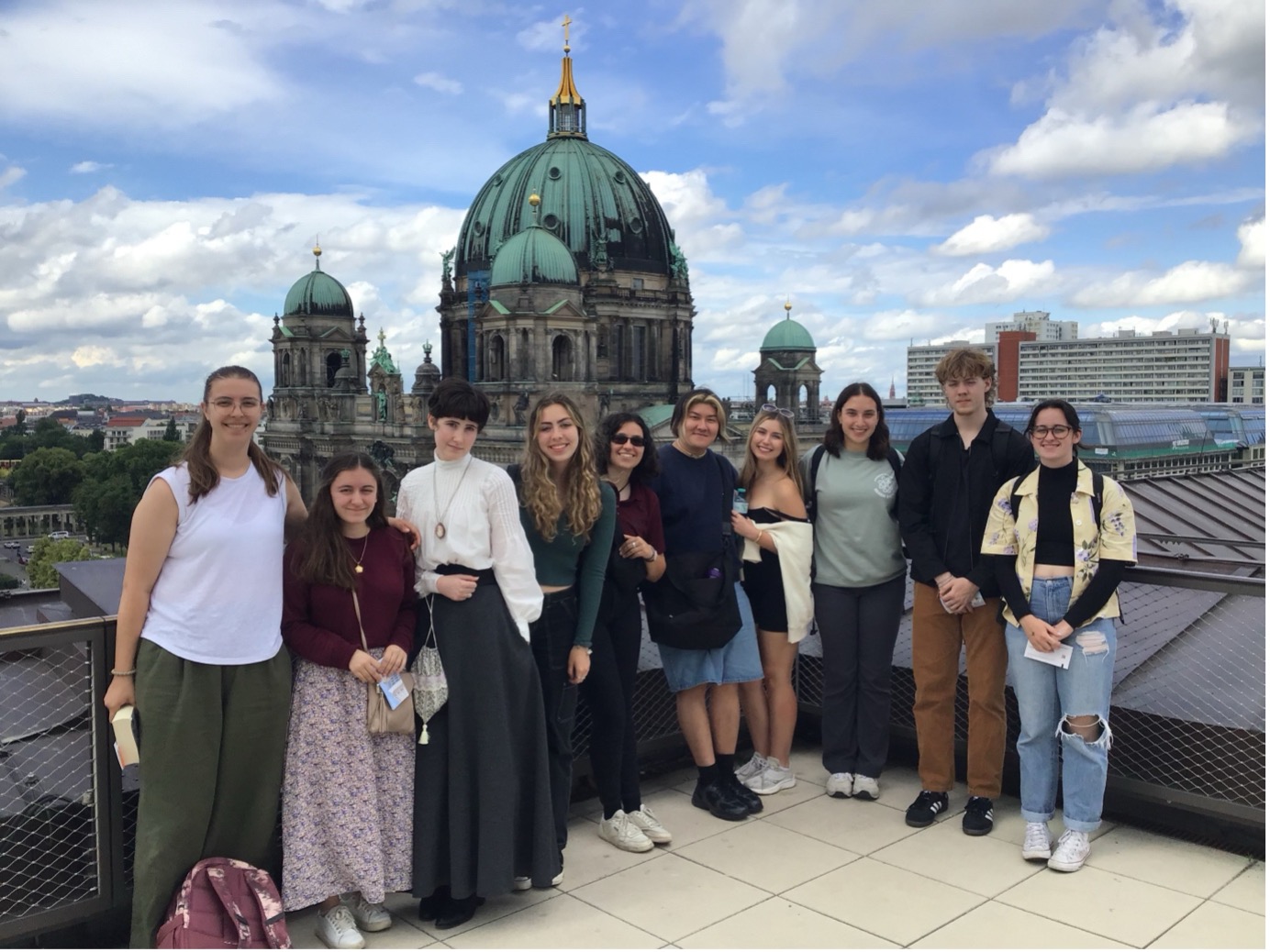
For many decades, the University of Rochester has also offered offers a junior or graduating senior German major or minor a fellowship-supported post-bac year of study at the University of Cologne. One student is awarded the opportunity to study at the University of Cologne with full financial support. It’s a fabulous opportunity especially for students who might be interested later in applying to graduate or professional programs in Germany. Contact Lisa Cerami at lisa.cerami@rochester.edu to find out how and when to apply.
There are also a number of study abroad and internship programs in Germany, Austria or Switzerland that students might select that are facilitated by other universities or vendors. The Center for Education Abroad Office can assist you in selecting a program that works for you and your majors. Studying abroad in Germany is not only for German majors! Students can tailor study abroad and/or internships to their interests and professional goals, in fields like banking, economics, computer science, lab sciences and politics.
There are several scholarships and fellowships that students can apply for to help fund study abroad. See the finances page of the education abroad site for more information.
Language Placement
Advanced Placement (AP) scores or International Baccalaureate (IB) rankings assist departmental advisors in finding the right course level for you. Information on how you learned the language or languages you know will also help us advise you on the most appropriate courses for you in MLC.
For students with previous experience with the German language, the first step is to take the online placement exam. You will receive a score that will be used along with the other information you provide to help determine your placement. For instructions for how to login, see our online placement exam instructions page. Students who have not studied German previously and who are not heritage speakers of German may register for GRMN 101 without taking a placement exam.
Students will receive a “Course planning, placement, and recommendations” sheet with their language placement information from Academic Advising during Orientation and via email.
Contact information
Faculty
Lisa Cerami, Associate Professor of Instruction in German, Undergraduate Advisor, Placement Advisor
Tanja Beljanski, Lecturer in German
Martin Dawson, Visiting Assistant Professor of German
June J. Hwang, Associate Professor of German