
Kathren Sage
Graduate Student, Meyer Lab
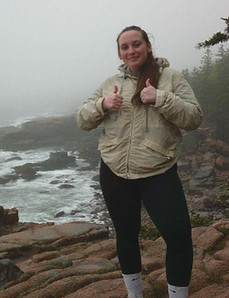
You work in a laboratory, what are you currently researching?
I work in the lab of Anne S. Meyer, where I study the ways in which Escherichia coli can be engineered to create living optical devices. The sea sponges Tethya aurantia and Suberites domuncula possess a silica biomineralization enzyme called silicatein which allows them to polymerize glass for the construction of their internal glass skeletons. By surface-expressing silicatein in E. coli, the bacteria can polymerize a shell of polysilicate, or bioglass, at their exterior, allowing them to capture and focus light as living microlenses. My research focuses on optimizing the optical properties of these engineered cells, determining their suitability for space applications, and developing them into living bacterial biosensors that provide an optical readout in response to environmental stimuli.
What was it that originally sparked your interest in biology?
I credit the start of my love of science to my mother and my grandfather. As a young child, my mom and grandpa would always point out natural phenomena and explain to me what it was and why it happened. They encouraged my love of science by taking me to museums, fossil and rock hunting, and exploring the natural world. I admired their curiosity, and as they both possess PhDs, my mom in experimental psychology and my grandpa in chemistry, at a very young age I knew that a PhD was something I wanted to do. They taught me to keep questioning everything and to always be curious about why things work the way they do. My immersion in learning about the natural world is really what made me love biology.
What do you enjoy most about working here at the U of R?
My favorite thing by far is the people I meet. I have met so many people from so many different walks of life. I love to learn about other people’s experiences as it broadens my world view and reminds me of how big and diverse the world really is. Not only that, but I have met some kind and intellectual people here, from faculty to peers, that have made my time here wonderful. I feel that these people have been incredibly supportive of my journey and I am very grateful to them.
What’s the most important thing you’ve learned about working here and/or studying biology?
I have learned quite a bit since starting my PhD here. The most important thing I learned is that there will always be things you don’t know, and that’s okay. The important thing is to make the effort to keep learning. There are so many new things to learn, from biological processes to new lab techniques, and learning these things will only make me a better scientist in the future. And while experiments may fail sometimes, there is always something to be learned about why that experiment failed, and what can I do or change in the future to reach a different outcome or reveal more information.
How do you unwind when you’re not in the lab?
When I am not in the lab, I really enjoy going for hikes or taking walks in nature, still looking for rocks and fossils. I also enjoy going to the gym and lifting or going to yoga classes. I love to paint and craft and watch horror movies. Most of all, I recharge by spending time with the people I love, my friends and family.