Though people are immersed in language every day, they are often unaware of its great structural complexity and beauty. The Department of Linguistics at the University of Rochester is committed to advancing our understanding of this remarkable human ability on several important fronts from documenting endangered languages and studying how sounds are produced, to analyzing sentence structure and building computational models of meaning.
Academics
Our faculty covers a wide range of subfields in linguistics which allows our students to participate in an exciting range of research projects, starting as undergraduates.
Our department explores a wide range of linguistic subfields: from documenting endangered languages and studying how sounds are produced, to analyzing sentence structure and building computational models of meaning. These areas reflect our commitment to both theoretical depth and empirical research, spanning the intersections of language, cognition, society, and technology.
Computational and Experimental Semantics and Pragmatics
This interdisciplinary area combines formal linguistics, cognitive science, and computer science to investigate how meaning is structured, processed, and interpreted. Research in our department examines how conceptual categories are reflected in grammatical categories, and how this knowledge can be applied to building natural language understanding systems. Faculty develop precision instruments to measure the distributional and inferential properties of linguistic expressions, and design scalable systems that synthesize this data, yielding both scientific insights into the structure of meaning and practical tools for advancing language technologies.
Faculty and students in our department travel into the field to work with native speakers of endangered languages, many of which are spoken by a dwindling number of people whose cultural traditions have been disrupted or displaced. Back in Rochester, we transcribe and analyze the recordings to produce detailed linguistic descriptions and, in some cases, help create a written version of the language for the first time. The stakes are high: when a language disappears, so does the cultural knowledge, history, and worldview of the people who spoke it. Preserving linguistic diversity isn't just about saving individual languages; it’s essential to understanding the full range of human language and cognition.
Morphology is the study of the structure and formation of words—and it plays a central role across the broader landscape of linguistic theory, intersecting with phonetics, phonology, syntax, and semantics. In our department, researchers explore a wide range of theoretical perspectives on what constitutes a word and how word forms are organized across languages. One approach treats morphemes as the foundational units of morphology, with words built up from smaller parts. Another approach focuses on fully inflected word forms and their relationships within paradigms, viewing morphology as an inferential system rather than one built from morphemes. These perspectives are explored through both formal analysis and computational modeling, particularly in the context of crosslinguistic variation and complex morphological systems. The department embraces this diversity of theoretical frameworks, using them to deepen our understanding of how words encode meaning and structure across the world’s languages.
Phonetics and phonology explore how speech is produced, perceived, and structured. Phonetics examines the physical and biological aspects of speech sounds, including how they're articulated and heard, while phonology analyzes how sounds are organized in linguistic systems and interact with meaning and grammar. In our department, research approaches speech as a purposeful and complex activity—the primary vehicle through which language is transmitted. Current projects include field phonetics and language documentation, the development of an interactive online speech atlas for Dene language communities, modeling vowel coding in the midbrain in collaboration with neuroscience and biomedical engineering, and cross-linguistic studies of tone and prosody. Past work has also included the use of ultrasound to study tongue movement during speech. This research bridges linguistic theory, experimental methods, and speech technology to deepen our understanding of human communication.
Semantics is the study of meaning in language, how the meanings of words and phrases combine based on their parts and syntactic arrangement. It connects closely with both lexical semantics (the study of word meanings) and the syntax-semantics interface (how sentence structure influences meaning). Pragmatics, by contrast, focuses on how language is used in context, how speakers convey and interpret intended meaning beyond the literal words. This includes the role of inference, shared knowledge, and conversational expectations. For instance, a question like “Can you pass me that bowl?” is typically understood as a request rather than a literal inquiry about ability, unless the context shifts, such as in a physiotherapy session. Together, semantics and pragmatics shed light on how language users construct, interpret, and negotiate meaning in everyday interaction.
Syntax is the study of the structure of sentences, how words combine into phrases and phrases into larger expressions that convey meaning. It explores the system that connects linguistic form (such as sounds or signs) with meaning, revealing properties of a uniquely human cognitive capacity. Research in our department approaches syntax from multiple theoretical perspectives, including derivational and constraint-based frameworks. Faculty and students investigate crosslinguistic patterns through fieldwork and typological comparison, as well as syntactic phenomena at the interface with semantics and morphology. Topics of study include anaphora, control and raising, perception verbs, and the structure of complex predicates, with a focus on languages from both Indo-European and non-Indo-European families. Syntax research here reflects a broader goal: to uncover the universal principles and language-specific rules that shape how humans build and understand sentences.
Typology, Historical Linguistics, and Sociolinguistics
This broad area of research explores how languages vary across cultures and time, and how language reflects and shapes social identity. Typology compares the structural features of diverse languages to uncover universal patterns and unique linguistic systems. Historical linguistics examines how languages change over time, while sociolinguistics investigates how language is used within communities, how it signals social, cultural, or regional identity, and how it evolves through contact, migration, and shifting power dynamics. Researchers in our department focus especially on language variation and change in endangered language communities, including processes of language shift and loss. Projects such as the Rochester Accent Project study local dialects to understand how language reflects the life, history, and identity of a region, while also documenting the ongoing effects of social change on language use.
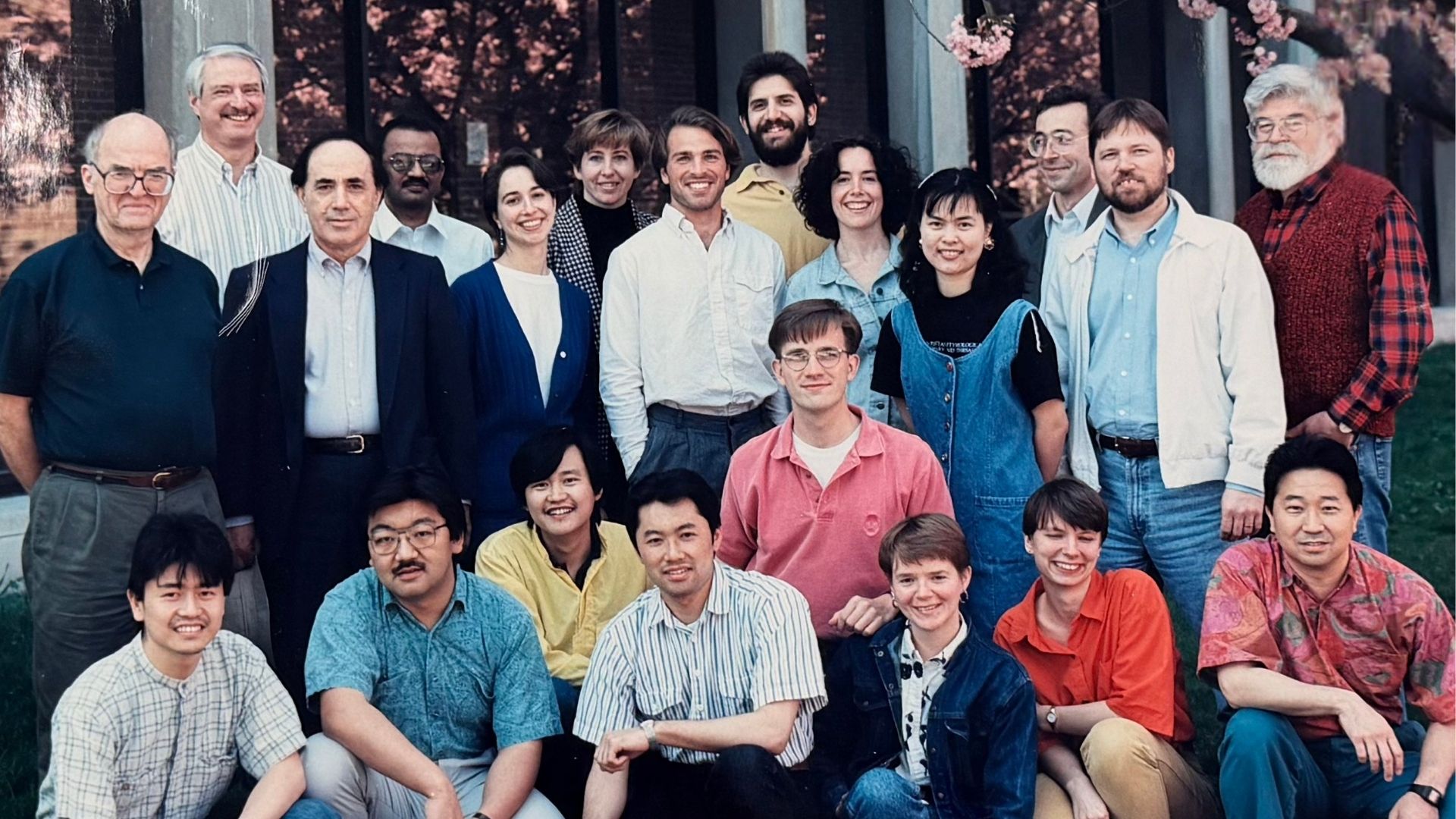
Pictured in this photo are early members of Rochester’s linguistics community—one year before the Department of Linguistics was officially founded in 1993—including faculty such as Greg Carlson (semantics), Tom Bever (psycholinguistics), Itziar Laka (syntax), Ted Supalla (sign language), Yoshihisa Kitagawa (syntax and Japanese), and others who shaped the department’s early years. Alongside them are PhD students who went on to distinguished careers across the globe. Many in this group became professors at universities in the U.S., Japan, Taiwan, Italy, Spain, and Canada, while others left a legacy in fields such as computation, medicine, and authorship. Together, they represent the department’s foundation and its enduring international reach.
1970 - Department of Linguistics and Languages
The Department of Linguistics and Languages offered bachelor's, master's, and doctorate degrees in linguistics. Through the 60's and 70's, the department saw a thriving doctoral program.
1980 - Department of Foreign Languages, Literatures, and Linguistics
Around 1980, the Department of Linguistics and Languages was merged with a Foreign Literatures department to form a unit called “Department of Foreign Languages, Literatures, and Linguistics," or simply FL3 for short. Linguistics thus became one program among several core programs.
1987 - Growth Through Connection with Cognitive Science
The University sought to establish a strong research presence in Cognitive Science. Language was central to many of the field’s fundamental questions. Thus, the Linguistics program was intended to be a full participant in Rochester’s interdisciplinary cognitive science effort.
The program developed through a series of strategically complementary appointments. Greg Carlson joined the senior faculty in 1987, followed by junior linguist Andy Barss in 1988. Yoshihisa Kitagawa, a member of the Japanese program with expertise in syntax, further strengthened the department’s linguistic profile. Elissa Newport joined Psychology with a focus on language development in children, while Ted Suppalla brought expertise in American Sign Language and helped establish an ASL program within Linguistics. Finally, Lenhart Schubert joined Computer Science, adding expertise in computational linguistics. Together, these appointments helped build the interdisciplinary foundation that connected Linguistics to Rochester’s broader cognitive science enterprise.
1993 - Department of Linguistics
In 1992, the department was divided into two departments: a Department of Linguistics and a literature department, eventually named Modern Languages and Cultures, which would assume responsibility for modern-language teaching. The reorganization thus transferred language-teaching responsibilities from Linguistics to the literature faculty. It was implemented in the fall of 1993.
1999 - Revamping the Undergraduate Program
By 1999, the undergraduate curriculum remained largely unchanged from its pre-1987 form. Ted Supalla, Joyce McDonough, Jeff Runner, and Mike Tanenhaus as committee chair considered how to revamp the undergraduate program. The revision proved highly successful. Within little more than half a decade of its implementation, Linguistics had become the fastest-growing major in the College.
2015 - Expanding Master's Programs and Research
With the undergraduate program thriving, the department turned its attention around 2015 to expanding its master’s-level offerings. In addition to the MA in Linguistics, it established an MA in Language Documentation and Description and an MS in Computational Linguistics.
By the end of the decade, the department had also made a series of significant faculty appointments that further expanded its research strengths, including Scott Grimm, Nadine Grimm, Maya Abtahian, Aaron White, Ash Asudeh, and Asia Pietraszko.
2023 - Revamping the Doctoral Program
In the 2020's, the department substantially overhauled the doctoral curriculum, creating new courses, updating requirements, and modernizing the program. Within five years, the PhD program grew from a single student to 18.
To support this growing graduate community, the department also created a Graduate Student Resources Hub, an extensive section of the department’s website providing students with tools, information, and resources to support their academic and professional development.
2025 - Rhythm of Visibility
The department undertook a significant, multi-stage digital transformation. The website was modernized, Instagram relaunched, and research and students brought to the forefront.
The department also established a more consistent rhythm of sharing news and events across its website and social channels, making the activity of the department more visible and accessible.
The new digital presence replaced static content with dynamic layouts, clearer information architecture, and a stronger visual hierarchy. Research themes, lab spotlights, and examples of the field’s broader impact now help convey a fuller picture of linguistics at Rochester—not only what the department studies, but why it matters, how it connects across disciplines, and how students can participate. Research is presented as an active, accessible part of the department’s identity for prospective students, collaborators, and the broader public.
Contact Us
Get in Touch
For more information about the Department of Linguistics, our programs, our research, or our courses, send us an email.