
Jeremy Coburn coauthored a sketch grammar of Hadza published in Studies in African Linguistics
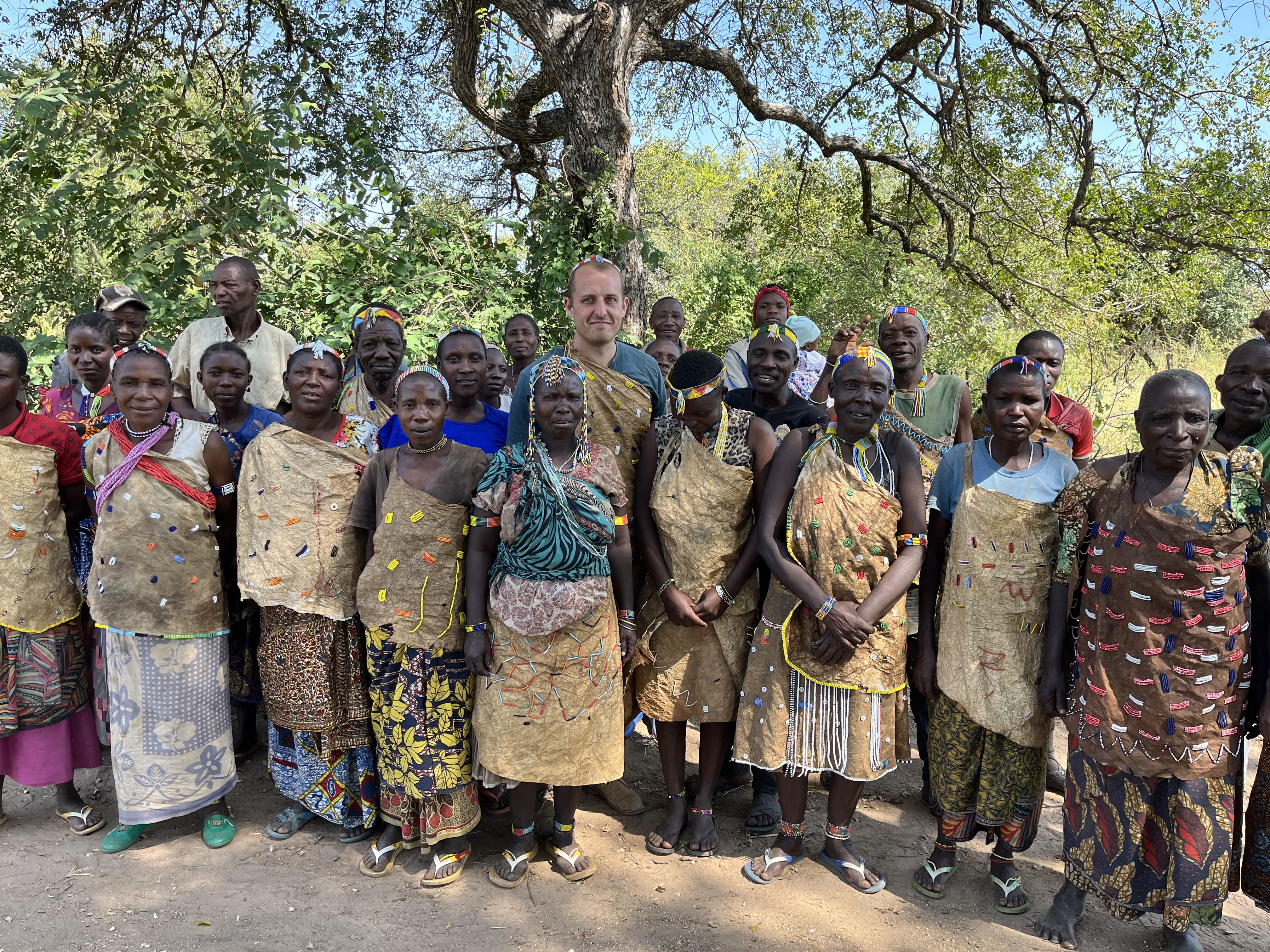
"A sketch of Hadza grammar" by Andrew Harvey, Richard Griscom, and Jeremy Coburn is a notable step in the description and documentation of the Hadza language, an endangered language isolate spoken in northern Tanzania. Although Hadza is well known among linguists, particularly for its use of click consonants, this paper brings together and synthesizes decades of prior scholarship (both published and unpublished) in a compact and accessible way for the first time in a sketch grammar. The grammar presents the segmental and tonal inventories and discusses key components of the morphosyntax.
Highlights include:
A phoneme inventory of 64 consonants (including clicks and ejectives) and 5 vowel qualities with length and (marginal) nasal contrasts
A two-level (High/Low) tone system with detailed discussion of lexical tone distribution, toneless morphemes, and tone polarity
Two grammatical genders governing extensive nominal and verbal agreement
A richly suffixing noun morphology (diminutive, gender-number, associative, locative, possessive, etc.)
Complex verbal morphology (pluractional, itive, ventive, causative, applicative, passive, reciprocal, and more) and frequent verb-auxiliary constructions
Why it matters: As a compact, accessible reference grounded in community collaboration (including Hadza researchers' own documentation work), this sketch offers a valuable resource for typologists, Africanists, and documentary linguists, and supports ongoing language maintenance efforts within the Hadza community.
The full article is available open access via Studies in African Linguistics, Vol. 55 (1&2) at https://journals.flvc.org/sal/article/view/135198.
A fun fact about the paper: rather than settling author order by convention, Harvey, Griscom, and Coburn decided it the Hadza way—with rounds of lukutchuko, a traditional game of chance played with baobab-bark discs. A fitting touch for a paper deeply rooted in collaboration with the Hadza community.