
Complex Systems
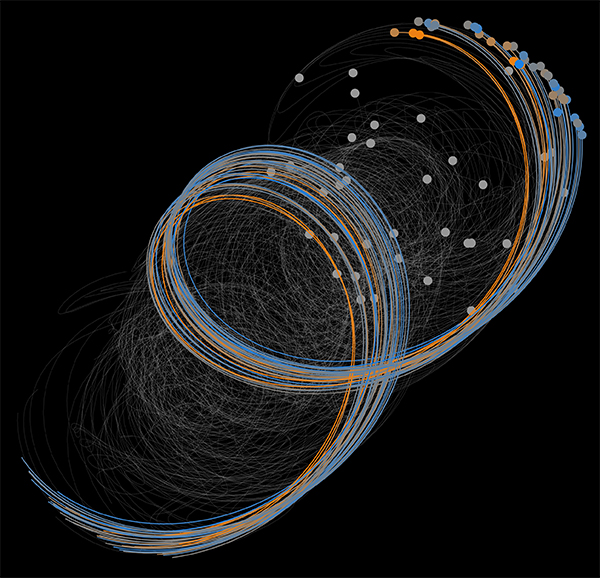
The physics of complex systems asks how interactions among many components give rise to collective behavior across physical, biological, technological, and social systems. Using ideas from statistical physics, nonlinear dynamics, network science, information theory, and nonequilibrium thermodynamics, our faculty develop mathematical and computational frameworks to understand how complex systems emerge, evolve, and respond to changing environments.
Department Research
Our faculty conduct theoretical and computational research on complex systems in contexts ranging from living matter and urban systems to artificial intelligence:
Adam Frank
Our group at the University of Rochester studies the physics of complex systems, seeking to understand how the physical principles that govern energy, information, and organization give rise to the phenomena we associate with life. We investigate how living systems process semantic information—information that carries meaning and function for the organism that holds it—and how such information emerges from, and feeds back into, the thermodynamics and dynamics of the underlying physical substrate. Drawing on statistical mechanics, nonequilibrium thermodynamics, and dynamical systems theory, our research probes questions such as how biological systems store and act on meaningful information, how adaptation and learning arise from physical constraints, and what distinguishes living matter from inert matter at a fundamental level. By combining theory, computation, and collaboration with experimentalists, we aim to build a physical understanding of life as an information-processing phenomenon rooted in the laws of physics.
Gourab Ghoshal
Our research spans a broad range of topics, including network science, human mobility and urban dynamics, infectious disease spreading, neuroscience, biological organization, the origins of life, and artificial intelligence. While these systems differ widely in scale and mechanism, they often exhibit common organizing principles. A central goal of our work is to identify those principles and develop theoretical frameworks that apply across disciplines.
One area of our research examines the role of information in complex systems. We investigate how information is generated, transmitted, and transformed in biological, neural, and social systems, including questions surrounding semantic information, adaptation, learning, and the emergence of agency. We are also interested in how machine learning can provide new tools for understanding complex systems and accelerating scientific discovery.
Our work combines analytical theory, large-scale computation, data-driven modeling, and close collaboration with experimentalists. By bringing together ideas from physics, biology, computer science, and the social sciences, we seek a deeper physical understanding of complexity across systems ranging from molecules and cells to brains, cities, and societies.
Yuanzhao Zhang
Our group works at the intersection of nonlinear dynamics and machine learning. One thread of our research concerns collective dynamics on networks: How do interacting units—power-grid generators, circadian neurons, flashing fireflies—organize themselves into synchronized rhythms and other collective states? How does the pattern of interactions, including higher-order interactions that couple many units at once, shape the stability and resilience of the emergent dynamics? To answer these questions, we develop mathematical and computational tools ranging from bifurcation analysis, basin cartography, and reservoir computing.
A second thread explores the growing synergy between machine learning and complex systems. We study foundation models for dynamical systems, asking when and how large AI models trained on diverse time-series data can forecast, reconstruct, and control nonlinear dynamical systems. Conversely, we treat neural networks themselves as dynamical systems, using ideas from nonlinear dynamics and statistical physics to understand how they learn and generalize—with the ultimate goal of making AI a more interpretable and reliable tool for scientific discovery.