
Open-source codes and datasets from the Olugboji Planetary Imaging and Earth Hazards Lab, organized by the three stages of the lab’s methods program. Each tool links to its code, its archived release and the paper to cite.
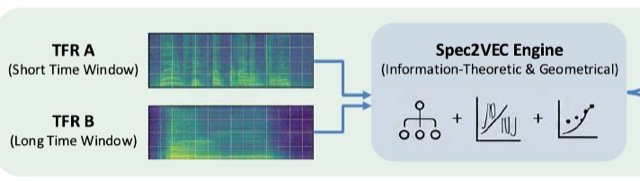
Turns spectrograms into interpretable feature vectors that sort marsquakes, eruptions and other planetary signals with few labels.
docker pull urseismogate.earth.rochester.edu/spec2vec:latestStage 1 · Advanced Signal Denoising
Recovering reliable structure from the sparsest, noisiest seismic records.
Separates direct mantle conversions from crustal multiples and noise in receiver functions using a sparse Radon transform.
Detects and removes reverberations from sediments, oceans and glaciers in any seismic recording, without prior structure.
Removes sediment reverberations from ocean-bottom receiver functions; the forerunner of FADER.
Probabilistic deconvolution that separates SS waves from faint precursors to image mantle discontinuities with sparse data.
Stage 2 · AI-Powered Seismic Refinery
Physics-informed AI that turns raw vibration into high-fidelity structural information.
Physics-informed neural network that extracts surface-wave dispersion from ambient-noise correlations.
Deep algorithm unrolling that separates reflected wavefields for seismic migration.
Datasets & models
Open models and datasets behind the lab's continental and mantle maps.
Africa's crustal shear-velocity model, crustal taxonomy and ambient-noise phase-velocity maps, built from the largest catalog of short-period surface-wave measurements.
About 100,000 Love- and Rayleigh-wave phase-dispersion measurements from ambient noise across Africa, for testing and updating crustal models.
Dataset and codes for classifying upper-mantle layering beneath the United States from receiver functions.
All datasets and models, with downloads and citation details: Open Data
Earlier tools
Command-line receiver-function utility: harmonic stacking, depth migration and multi-layer H-K stacking.
All lab code on GitHub
github.com/URseismology 26 public repositories: tools, datasets, notebooks and course materialBrowse →When you use a tool, please cite its paper and its archived release (Release DOI). Questions and bug reports are welcome as issues on each tool’s GitHub page.