
Data and models behind the lab's papers, each archived with a DOI. Please cite both the paper and the dataset. Data are CC BY 4.0 unless noted.
Our data policy
To promote the reproducibility of research and the creation of citable, high-quality data products, the lab is committed to providing open access to all published datasets. Open access ensures that scientific findings can be independently validated and that the data can support secondary studies across a range of disciplines. By enabling seamless access to these datasets, the lab aims to advance transparency, collaboration and innovation in research.
Further reading: McNutt (2015), Data, eternal. Science 347, 7
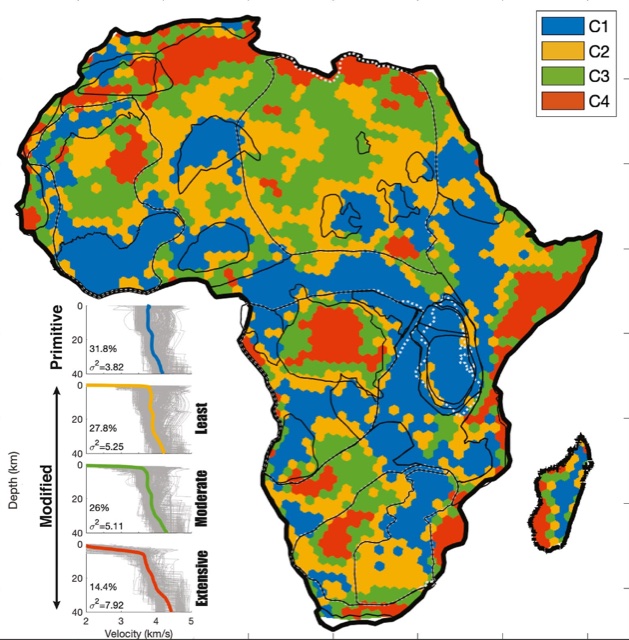
Africa's crustal shear-velocity model, crustal taxonomy and ambient-noise phase-velocity maps, built from the largest catalog of short-period surface-wave measurements.
Earth models
Depth of the lithosphere-asthenosphere boundary across the African Plate, with uncertainties, from a vertically polarized shear-wave model.
Sediment thickness, Moho depth, Vp/Vs and negative velocity gradients compiled from active and passive seismic experiments, with crustal and mantle thinning factors.
Dataset and codes for classifying upper-mantle layering beneath the United States from receiver functions.
Seismic datasets
About 100,000 Love- and Rayleigh-wave phase-dispersion measurements from ambient noise across Africa, for testing and updating crustal models.
Receiver functions for 74 high-quality and 430 lower-quality stations, discontinuity statistics and thermal tests behind the study of Africa's upper-mantle discontinuities.
Ps receiver functions for East Africa, denoised with CRISP-RF at 1 Hz, that image the Moho and upper-mantle discontinuities.
Ocean-bottom and borehole seismic data with processing notebooks, used to image the lithosphere-asthenosphere boundary beneath normal oceanic mantle.
Derived spectral data sets and computed files behind Spec2VEC, built from the IRIS Exotic Seismic Events Catalog, tectonic earthquakes and the PoroTomo DAS array.
Datasets are archived on Zenodo with DOIs; large raw and derived files are served from the lab’s data server. ADAMA is also distributed through the EarthScope Consortium‘s Earth Model Collaboration (EMC). Code for these datasets is listed on the Software page. Updated November 2026.