
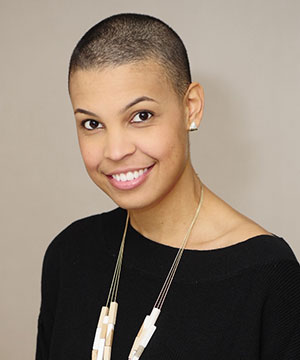
Kathryn Mariner
she/they
Associate Professor of Anthropology
PhD, University of Chicago, 2015
- Office Location
- 444 Lattimore Hall
- Telephone
- (585) 275-8734
- Fax
- (585) 273-5331
Office Hours: by appointment
Research Overview
Professor Mariner's research examines the relationship between social inequality and intimacy in the United States, asking how people form attachments against a backdrop of structural violence. As a cultural anthropologist additionally trained and licensed in clinical social work, she investigates how historical and contemporary structures of power, such as race and racism, shape how people construct notions of family, community, and self in their everyday lives. Her research ranges from transracial adoption and alternative kinships, to race and placemaking, to beauty and embodiment.
Her first book, Contingent Kinship (University of California Press, 2019), is based on research at a private adoption agency specializing in the transracial placement of Black and biracial children in Chicago. In developing the theoretical concept of “intimate speculation,” the book explores the speculative logics of domestic transracial adoption, by attending to how raced and classed exchanges of power, money, and knowledge produce notions of the Black child as a highly contingent imagined future. The conditions of possibility for this adoptive future often include historical legacies of dispossession and the devaluation of Black motherhood. Witnessing this process unfold within Chicago's landscape of stark race and class segregation has informed Professor Mariner's current interest in the relationship between social inequality and physical space.
Professor Mariner's second research project, fertileground, investigated the relationship between race and placemaking in Rochester, New York. In order to understand how individuals from marginalized groups build physical spaces of community within the context of hypersegregation, the project utilized community-based and participatory approaches to fieldwork, and employed the methods of observant participation, interviews, mapping, photography, and artistic production to capture the many ways residents create and sustain lifeworlds in a city sometimes described as “dying,” and where certain racialized spaces in particular have been problematically termed “fatal.” fertile ground sprouts from three existing intellectual traditions: theories of space and place, urban ethnography and history, and feminist and Black geographies. The research has given rise to a book (fertile ground in the flower city, forthcoming with Duke University Press in 2027), six zines, an undergraduate research training program (funded by an NSF CAREER Award), and a series of photography installations.
Recently, Professor Mariner launched a new research agenda, with the support of a Mellon New Directions Fellowship. Informed by anthropology and critical science studies, Painting with Plastic considers the social, technical, environmental, and aesthetic politics of beauty treatments. As part of this new direction, Professor Mariner will be on leave in 2027 to pursue training in cosmetic science and nail technology. Through an examination of the confluence of beauty, plastic, and the body/environment, and their imbrications with questions of race/ethnicity, immigration, labor, gender, and power, this new project illuminates the cultural and aesthetic importance of nails and nail artistry (particularly for multiply marginalized subjects), while investigating the often overlooked (by humanists and social scientists) cosmetic science of evolving beauty technology. A central contradiction lies at the heart of the contemporary manicure: application of nail enhancements is a mode of gendered, raced, and classed labor, artistic self-expression, and a complicated respite for “self-care” in late-stage capitalism, while at the same time the plastic that enables this art form derives from fossil fuels, is increasingly found as miniscule particles in human and non-human flesh, and comprises entire pseudo-land-masses in Earth’s oceans. Painting with Plastic promises to illuminate the immense political and environmental stakes of beauty rituals, which are often seen as the frivolous domain of superficial feminized subjects, as well as bring attention to the intersection between technical, social, and aesthetic knowledges.
Research Interests
- intimacy and social inequality
- politics of race, class and gender
- temporality
- kinship and adoption
- care
- social work
- space and place
- visual anthropology
- beauty and embodiment
- United States
Selected Publications
Books
- Mariner, Kathryn A. 2027. fertile ground in the flower city. Durham: Duke University Press.
- Mariner, Kathryn A. 2019. Contingent Kinship: The Flows and Futures of Adoption in the United States. Berkeley: University of California Press.
- Interview about Contingent Kinship in Anthropology News
Journal Articles
- Mariner, Kathryn A. 2022. “'Where Are All the Black People At?': Landscapes of Erasure in the Flower City." Transforming Anthropology. https://doi.org/10.1111/traa.12226
- Mariner, Kathryn A. 2022. "Citation." Feminist Anthropology.https://doi.org/10.1002/fea2.12074
- Mariner, Kathryn A. 2021. "American Elegy, Reflux: American Aspiration." Public Culture 33(3): 289-303. doi: 10.1215/08992363-9262821
- Shannon, Jerry, Hannah Torres, Kathryn A. Mariner, and Timothy Hawthorne. 2021. "Practicing Community Geography in Times of Crisis."GeoJournal. doi: 10.1007/s10708-021-10529-9
- Mariner, Kathryn A. 2020. "On Needing Black Studies." InVisible Culture: An Electronic Journal of Visual Culture 31.
- Mariner, Kathryn A. 2020. "American Elegy: A Triptych." Public Culture 32(1): 5-23. doi: 10.1215/08992363-7816269
- Mariner, Kathryn A. 2019. "White Parents, Black Care: Entanglements of Race and Kinship in American Transracial Adoption." American Anthropologist 121(4): 845-56. doi: 10.1111/aman.13312
- Mariner, Kathryn A. 2019. "'Who You Are in These Pieces of Paper': Imagining Kinship through Auto/Biographical Adoption Documents in the United States." Cultural Anthropology 34(4): 529-45. doi: 10.14506/ca34.4.03
- Mariner, Kathryn A. 2018. "The Specular Un/Making of Kinship: American Adoption's Penetrating Gaze." Ethnos: Journal of Anthropology 83(5): 968-85. doi: 10.1080/00141844.2017.1377744
Teaching
- ANTH 101: Cultural Anthropology
- ANTH 104: Contemporary Issues: Reproduction
- ANTH 200: Anthropological Research and Methods
- ANTH 204: Ethnographic Themes: American Kinship(s)
- ANT 235: The Black Body: Intersecting Intimacies
- ANTH 254: Feminist Science Studies
- ANTH 261/2: Local Ethnography and Archiving Seminar
- ANT 288: The Social Construction of Whiteness
- ANT 307: Race and Space in the City
Honors
- New Directions Fellowship, Mellon Foundation, 2026-2028
- Undergraduate Social Sciences Professor of the Year, University of Rochester Students' Association, 2022
- National Science Foundation CAREER Award, 2021-2026
- Woodrow Wilson Career Enhancement Fellowship, Institute for Citizens and Scholars, 2019
- University Research Award, University of Rochester, 2018
- W.E.B. DuBois Award for Educational Excellence, University of Rochester Black Students' Union, 2018
- Internal Junior Fellow, Humanities Center, University of Rochester, Fall 2018
- Lichtstern Distinguished Dissertation Prize, University of Chicago Department of Anthropology, 2016
- Mellon/ACLS Dissertation Completion Fellowship, 2014-2015
- National Science Foundation Graduate Research Fellowship, 2008-2011
- Mellon Mays Fellowship, 2006