
From sound stream to meaning
Language scientist spotlight: Chigusa Kurumada
Chigusa Kurumada studies how children and adults interpret communicated and implied meanings from speech sounds.
Speech contains much more variability, and requires much more interpretation, than you might think. As Kurumada explains it, “it's not that what we say is nicely segmented… it's just a whole unsegmented continuous sound stream, and somehow we make sense of it.”
Early in her language science research, Kurumada discovered her interest in the fact that even a small variation in the speech stream can cause people to hear different words, meanings, and structures. For example, consider the difference between "I LOVE you" (not just “like” you) and "I love YOU" (not someone else).

"I LOVE you" vs. "I love YOU."
At the same time, we can ‘tune out’ other differences.
“Even when two people try to say the same word in the same way, the actual physical signals that they produce are quite different from each other. But you can recognize them as the same.”
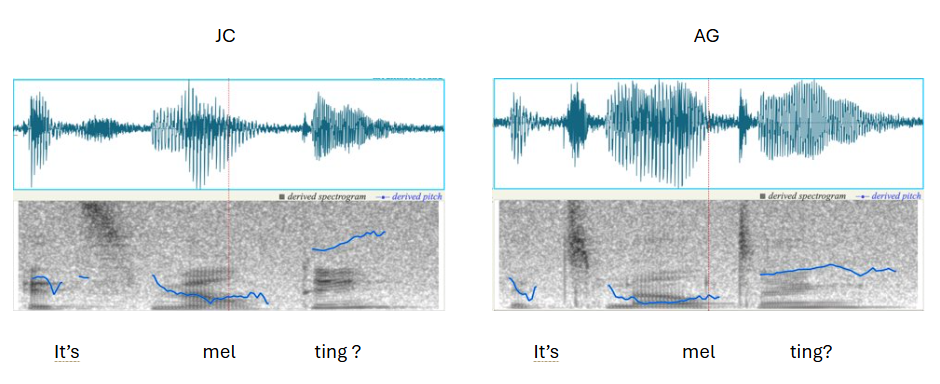
These spectrograms depict two people asking the same question: “It’s melting?” Listeners can recognize this, despite the speakers’ very different speech signals and levels of rising intonation at the end of the question.
Kurumada’s Kinder Lab stands at the intersection of semantics, pragmatics, and phonetics and phonology to ask: “how do we extract some meaningful units out of this really noisy, variable speech signal? And then how do we actually combine all the knowledge to understand what the other person must have wanted to say?”
Although kids can learn new languages easily compared to adults, they don’t initially have the same aptitude for understanding implied meanings.
The Kinder Lab’s recent studies with autistic and non-autistic teens highlight that perception alone may not be responsible for this skill gap. A significant portion of autistic people have acute sensitivity to auditory information, making them more responsive to small changes in pitch. But compared to their non-autistic peers, autistic adolescents tend to have a harder time picking up on a speaker’s non-literal meaning.
In collaboration with autism specialist Dr. Loisa Bennetto (URochester Psychology), Kurumada’s research is finding evidence that it’s adaptivity, not sensitivity, that young children and autistic folks struggle with.
“Because speakers are so different from each other, you have to be able to switch back and forth…. if the flexibility is not there, that can create a difficulty in understanding.”
Often science has attributed this kind of plasticity to kids, explaining their ability to easily learn new languages. But Kurumada says that her field is learning this flexibility actually continues throughout our adult life. Exposure to more types of speech and speakers continues to change how we understand other people throughout our lives.
The next time you exchange small talk with a stranger, take a moment to marvel at the fact you can understand each other.
Chigusa Kurumada is an Associate Professor of Brain and Cognitive Sciences at the University of Rochester.